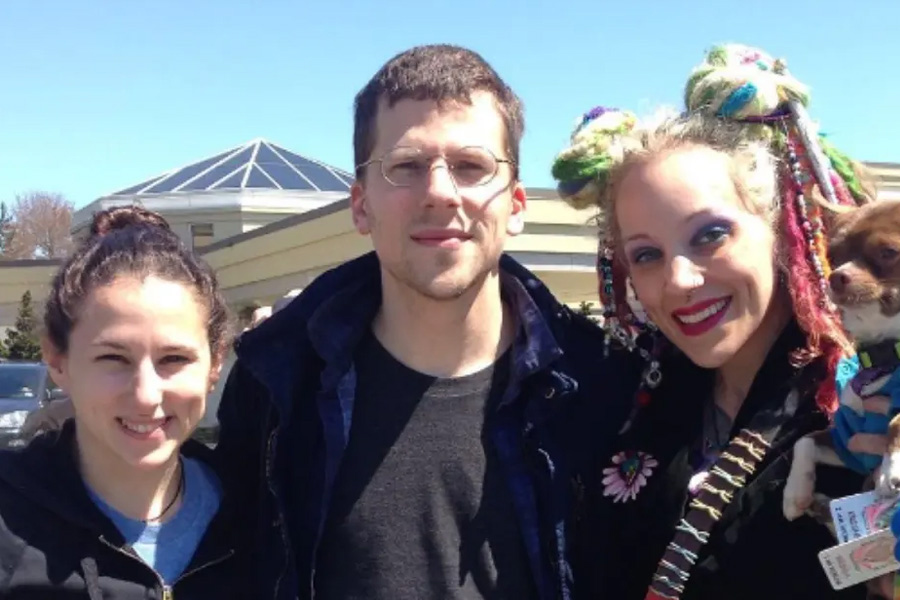
A Family Name, a Private Compass
I think one of the most interesting things about Kerri Eisenberg is not that she comes from a recognizable family, but that she seems determined to let the family name be only the beginning of the story. In a culture that loves clean labels and simple arcs, she reads like a restless sketchbook. Her life sits at the intersection of performance, visual art, teaching, and advocacy, and each line seems to tug in a different direction. That tension gives her presence a certain charge. She is not trying to fit neatly into a single frame. She is building the frame while moving inside it.
That matters because public identity often gets flattened. The louder the surrounding spotlight, the easier it is to assume the people near it are defined by proximity alone. Kerri Eisenberg complicates that idea. She belongs to a family with a familiar public footprint, yet she has carved out a path that feels deliberately less polished and more immediate. I read that as a kind of artistic discipline. Not the discipline of stiffness, but the discipline of staying responsive. Staying awake. Staying willing to change.
Names as Creative Instruments
Names are never just names. They are doors, signals, costumes, signatures. In Kerri Eisenberg’s case, the move toward Kerry Vera and Kerry Vera Lea suggests a person thinking carefully about how identity travels through public space. A name can be a billboard, but it can also be a mask you can breathe through. I find that especially compelling in an era when so much personal branding feels overbuilt and airless. Her naming choices seem less like reinvention for spectacle and more like tuning a string until it rings true.
That kind of shift often tells me something about an artist’s internal weather. Maybe a new name marks a broader practice. Maybe it creates room for work that does not belong in a single category. Maybe it separates one mode of self from another without breaking the thread between them. Whatever the reason, the result is expressive. It suggests motion. It suggests that the work comes first, and the label follows behind, carrying the scent of the studio with it.
Performance as a Living Surface
When I look at Kerri Eisenberg’s work through the lens of performance, I do not see a traditional ladder with one rung leading obediently to the next. I see a mosaic. Acting, circus influenced movement, drag informed performance, and experimental stage work all appear to live in the same room. That kind of range is not random. It reflects a comfort with edges. The borderland between disciplines is often where a person reveals the most about themselves.
I am especially drawn to artists who treat performance as a living surface rather than a fixed product. That means the work can hold contradiction. It can be playful and rigorous at the same time. It can be vulnerable without becoming fragile. It can flirt with spectacle while refusing to become empty spectacle. Kerri Eisenberg seems to operate in that register. Her artistic identity feels tactile, as though it is built from rehearsal, risk, and instinct rather than from a single breakout moment.
Teaching, Coaching, and the Shape of Attention
There is something revealing about people who teach while they make art. Teaching requires translation. It asks a person to turn intuition into language without killing its spark. Kerri Eisenberg’s work as an educator and coach suggests that she understands art not only as expression, but as method. That changes the texture of her public image. She is not simply a creator standing apart from others. She is also someone helping other people find their balance, voice, and rhythm.
I think that matters because teaching often exposes what an artist truly believes. If the work is only about self display, instruction becomes hollow. But if the work is about process, attention, and patience, then teaching becomes an extension of the art itself. It becomes a second stage, one with less applause and more trust. In that sense, Kerri Eisenberg’s teaching life feels like a continuation of her performance life, only quieter and more intimate. The audience is smaller, but the stakes are still real.
Visual Art and the Power of Imperfect Surfaces
Visual art gives Kerri Eisenberg another language, and perhaps one of the most interesting ones. Painting and mixed media can hold what speech cannot. They can absorb repetition, accident, and revision. They can look tidy from a distance and alive up close. That is part of why I think visual art suits someone with a layered creative identity. It gives shape to what cannot be neatly summarized.
I imagine her visual work as having the energy of a studio wall covered in traces. Not a sterile gallery machine, but a working environment full of fingerprints, scraps, and recoveries. Art like that can feel more honest because it preserves evidence of the hand. It refuses to pretend that inspiration arrives fully formed. It shows the weather of making. For an artist whose public life already resists simplification, visual art becomes a place where ambiguity is not a problem to solve. It is the point.
Advocacy and the Ethics of Attention
Kerri Eisenberg’s advocacy for animals adds another layer to her public identity. I find this especially important because activism changes how we read a person’s art. It suggests that beauty is not the only value in the room. Care is there too. Practice becomes ethics. Daily choices become part of the story. When someone speaks publicly about animals, fostering, rescue, or vegan living, the work moves beyond aesthetics and into a moral register.
That does not make the art less interesting. It makes it more grounded. The best advocacy often feels like an extension of temperament. It emerges from the same place as the creative work. In Kerri Eisenberg’s case, the connection seems to be compassion, but not a sentimental version of it. More like a disciplined attention to vulnerable life. More like a refusal to look away. That kind of commitment can give a public persona a pulse.
The Internet as Studio Window
A social feed can become a stage, a showroom, or a trap. What makes Kerri Eisenberg’s online presence compelling is that it appears to function more like a studio window. I get the sense of process rather than performance for its own sake. The posts seem to carry art, moments of daily life, and advocacy in the same breath. That blend makes the digital space feel less manufactured and more inhabited.
I am interested in people who use the internet without surrendering to it. There is a difference between using a platform and becoming a platform. Kerri Eisenberg appears to keep some distance from the machine, even while letting it carry her work outward. That distance can protect the integrity of the work. It also leaves room for surprise. Not everything needs to be explained in a caption. Not everything needs to be optimized into a brand funnel. Sometimes the image is enough. Sometimes the fragment is the point.
A Sibling Story Told by Contrast
It is tempting to measure siblings against one another when one family produces several public figures. I think that habit tells us more about the audience than about the people being compared. Kerri Eisenberg’s relationship to Jesse and Hallie Eisenberg is interesting precisely because her path does not mirror theirs. The contrast creates depth. It reminds me that families do not produce replicas. They produce variations, like themes played in different keys.
That is one reason her story feels worth telling on its own terms. She does not function as an appendix to someone else’s fame. She is a separate current. Her work in performance and art suggests a person more interested in texture than scale, more interested in expression than mass recognition. In a world obsessed with breakout narratives, that can look understated. It can also look brave.
FAQ
Who is Kerri Eisenberg?
Kerri Eisenberg is an artist, performer, educator, and advocate whose work moves across acting, visual art, coaching, and experimental performance. I see her as someone building a multifaceted creative life rather than a single-track career.
Why does she also use the names Kerry Vera and Kerry Vera Lea?
Those names seem to reflect a more developed creative identity, one that gives her room to present her work in different contexts. I read the shift as intentional, almost like changing the key without changing the song.
What makes her artistic path distinct?
What stands out to me is the way she blends stage work, visual practice, and teaching. She does not appear to treat art as one finished product. She treats it as a field of related practices, each one feeding the others.
How does family shape her public image?
Her family background gives context, but it does not define the whole picture. I think the more interesting story is how she uses that background as a starting point and then moves in a different creative direction.
What role does animal advocacy play in her life?
It seems central. Animal advocacy adds a layer of ethics to her public identity and connects her creative life to care, responsibility, and everyday action. For me, that makes the portrait feel more complete.
Where does her online presence fit into her broader work?
Her online presence appears to function like an extension of the studio. It offers glimpses of art, performance, and advocacy without reducing her to a single polished image. I see it as a space where process stays visible.
Is Kerri Eisenberg mainly an actress?
No, and that is part of what makes her interesting. Acting is only one part of a broader practice that also includes visual art, teaching, performance experimentation, and advocacy.
When Your Smile Is Telling You More Than You Think
What Happens Behind The Scenes In A Columbus Drunk Driving Case
How To Investigate A Neighbourhood Before You Call It Home